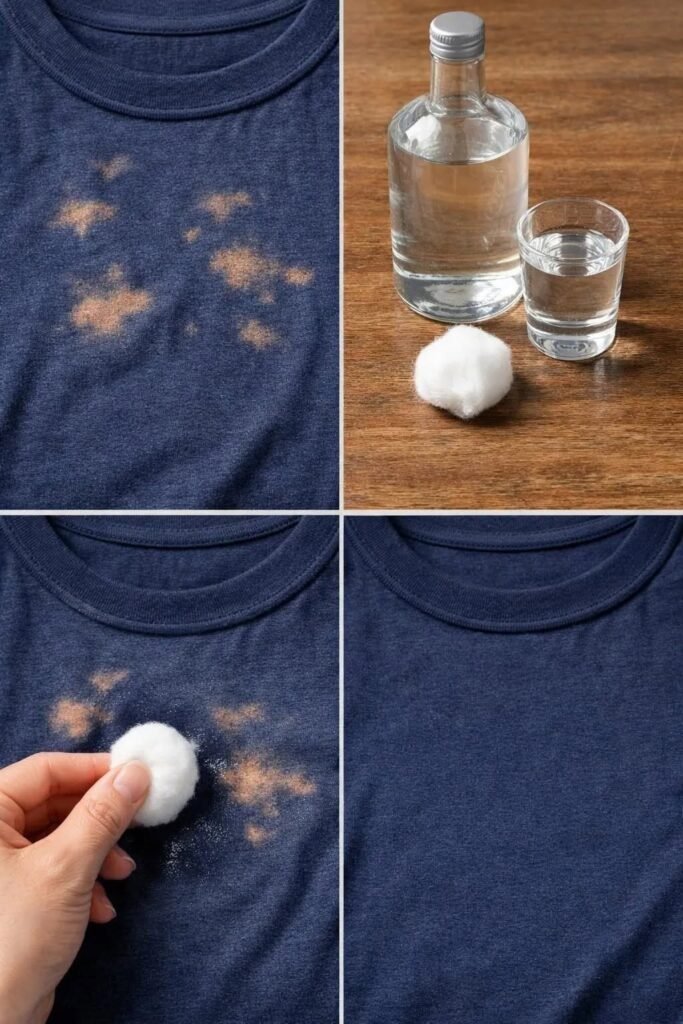

But before throwing them away, take a moment! There are several simple ways to repair or hide bleach damage and give your favorite clothes a second chance.
The secret is understanding what bleach actually does to fabric and choosing the right solution for the damage.
1. Understand Why Bleach Leaves Stains
First, here’s something important: bleach doesn’t usually create an ordinary stain.
Household chlorine bleach removes or changes the color of fabric by breaking down its dye pigments. That’s why a dark shirt might develop an orange, pink, yellow, or white patch after coming into contact with bleach.
Unfortunately, washing the garment repeatedly won’t restore the original color.
The good news is that you can often improve its appearance with a few creative techniques.
2. Try Fabric Dye to Restore the Color
One of the best solutions for larger bleach-damaged areas is fabric dye.
If your favorite black, navy, brown, or colored garment has a noticeable faded patch, fabric dye may help restore a more consistent appearance.
Here’s what to do:
-
-
Choose a fabric dye suitable for your garment’s material.
-
-
-
Read the manufacturer’s instructions carefully.
-
-
-
Select a color that closely matches the original fabric.
-
-
-
Test the dye on a hidden area first.
-
-
-
Apply it according to the product instructions.
-
-
-
Allow the garment to dry completely.
-
For cotton clothing, suitable fabric dyes can produce good results. Synthetic materials may require a different type of dye.
Keep in mind that dyeing the entire garment often produces a more even result than treating only the damaged patch.
3. Use a Fabric Marker for Small Bleach Spots
If the bleach damage is limited to a tiny area, a fabric marker might be the easiest solution.
For example, a black fabric marker can help disguise a small orange or white spot on black clothing.
Follow these steps:
-
-
Find a fabric marker in a matching shade.
-
-
-
Place cardboard behind the damaged area.
-
-
-
Apply the marker carefully.
-
-
-
Allow the color to dry.
-
-
-
Follow the manufacturer’s instructions for setting the color.
-
This method works best for small spots and minor discoloration.
Remember that the repaired area may still look slightly different under certain lighting conditions.
4. Turn the Damage Into a Fashion Design
Sometimes, the easiest solution is to stop trying to hide the damage!
Bleach can actually be used to create decorative patterns on suitable fabrics.
For example, a damaged dark T-shirt could become a creative tie-dye-inspired fashion piece.
You can consider:
-
-
Decorative patches.
-
-
-
Embroidery.
-
-
-
Fabric appliques.
-
-
-
Artistic stitching.
-
-
-
Iron-on designs.
-
A small decorative patch can completely cover an unwanted bleach mark while giving an old garment a fresh appearance.
Safety warning: Never experiment with bleach on clothing while wearing it. Do not mix bleach with vinegar, ammonia, toilet cleaners, or other household chemicals. These combinations can release dangerous gases.
5. Cover the Damaged Area With Embroidery
If you enjoy simple sewing projects, embroidery can be a beautiful way to repair bleach-damaged clothing.
You can use colorful thread to create:
-
-
Small flowers.
-
-
-
Leaves and vines.
-
-
-
Geometric patterns.
-
-
-
Stars and hearts.
-
-
-
Decorative initials.
-
For larger damage, consider using a fabric patch underneath the embroidery.
This technique works especially well on denim jackets, jeans, cotton shirts, and casual clothing.
6. Consider Turning the Entire Garment Into a New Style
If the bleach damage is widespread, repairing just one spot may not be enough.
Instead, consider changing the overall appearance of the garment.
For example:
-
-
Turn faded black jeans into a lighter fashion style.
-
-
-
Add matching patches to several areas.
-
-
-
Dye the entire garment a darker color.
-
-
-
Create a coordinated decorative pattern.
-
-
-
Transform an old shirt into a creative casual outfit.
-
Sometimes, a damaged piece of clothing can become something even more interesting.
7. What Should You Avoid?
There are several common mistakes people make when trying to repair bleach damage.
-
-
Don’t expect ordinary laundry detergent to restore removed color.
-
-
-
Don’t scrub the damaged area aggressively.
-
-
-
Don’t use additional household chemicals to neutralize the bleach.
-
-
-
Don’t apply fabric dye without checking whether it’s suitable for the material.
-
-
-
Don’t iron the garment until any cleaning products have been thoroughly rinsed out according to their instructions.
-
-
-
Don’t mix different cleaning chemicals.
-
If the bleach has weakened or damaged the fabric fibers, coloring the area won’t repair the physical damage.
Final Thoughts
A bleach accident doesn’t necessarily mean your favorite clothes belong in the trash.
Small spots can sometimes be disguised with fabric markers, larger faded areas may benefit from fabric dye, and decorative patches or embroidery can transform damaged clothing into something completely new.
The most important thing is to choose a repair method that matches the size of the damage and the type of fabric.
So, the next time bleach accidentally lands on your favorite clothes, don’t rush to throw them away. A little creativity might give them a second life!